It is a different style, and NVIDIA says so in its own documentation. The guidance for DLSS 5 states that the model remains limited to photorealistic rendering and is not designed for strongly stylised games — voxel art, illustrative looks, anything whose surfaces were never meant to behave like real ones. That is the vendor conceding the point the argument has been about since March.
Which leaves a more interesting question than “is it good”. If a relighting model is a style, what happens when you point it at art that was built on a different one?
Four Steps Up the Ladder
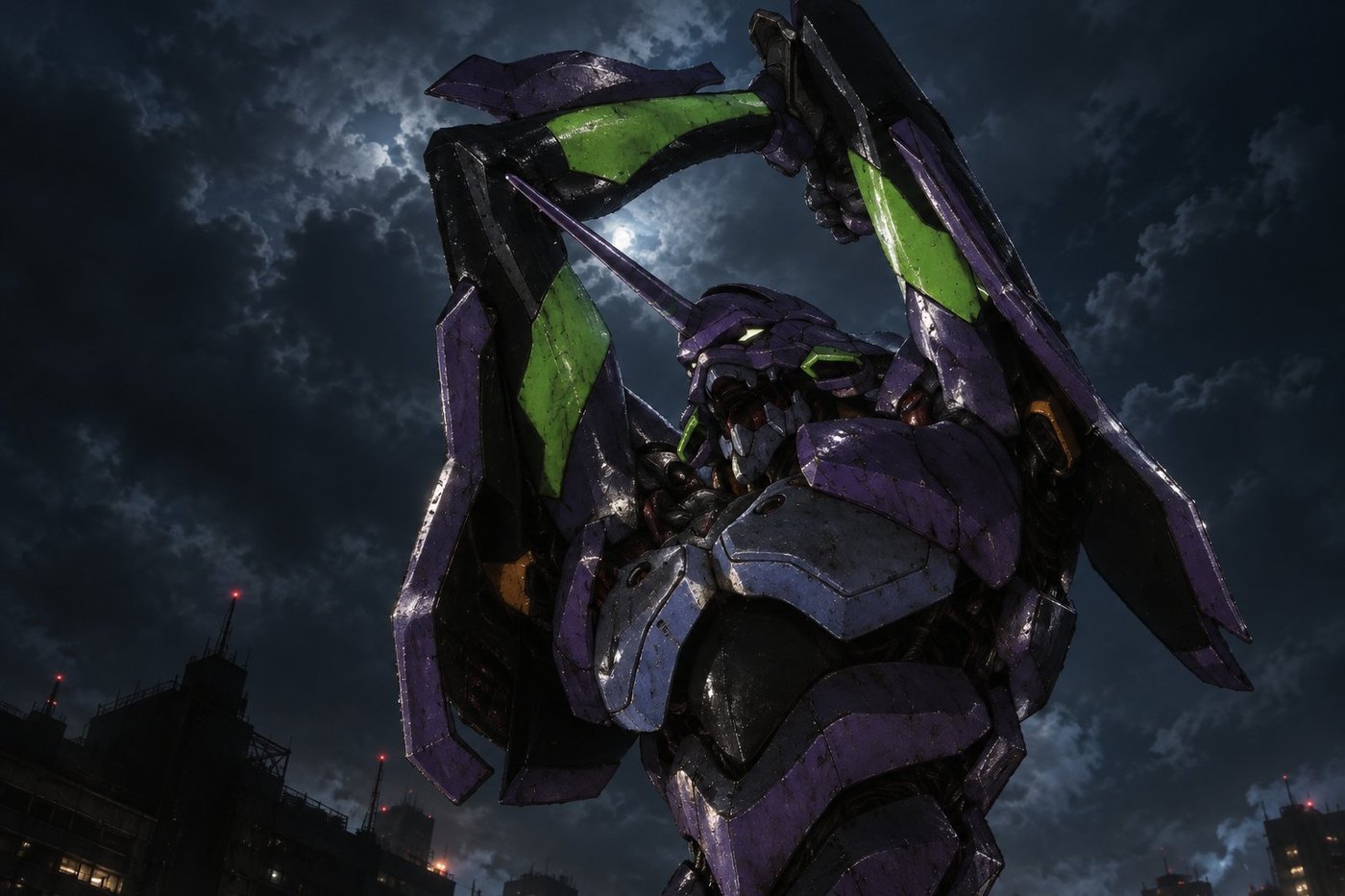
Below is one frame of hand-drawn cel animation taken through increasing amounts of neural relighting by BizziGroup. Same subject, same pose, same low angle. Step through it and watch where it stops being the thing it started as.

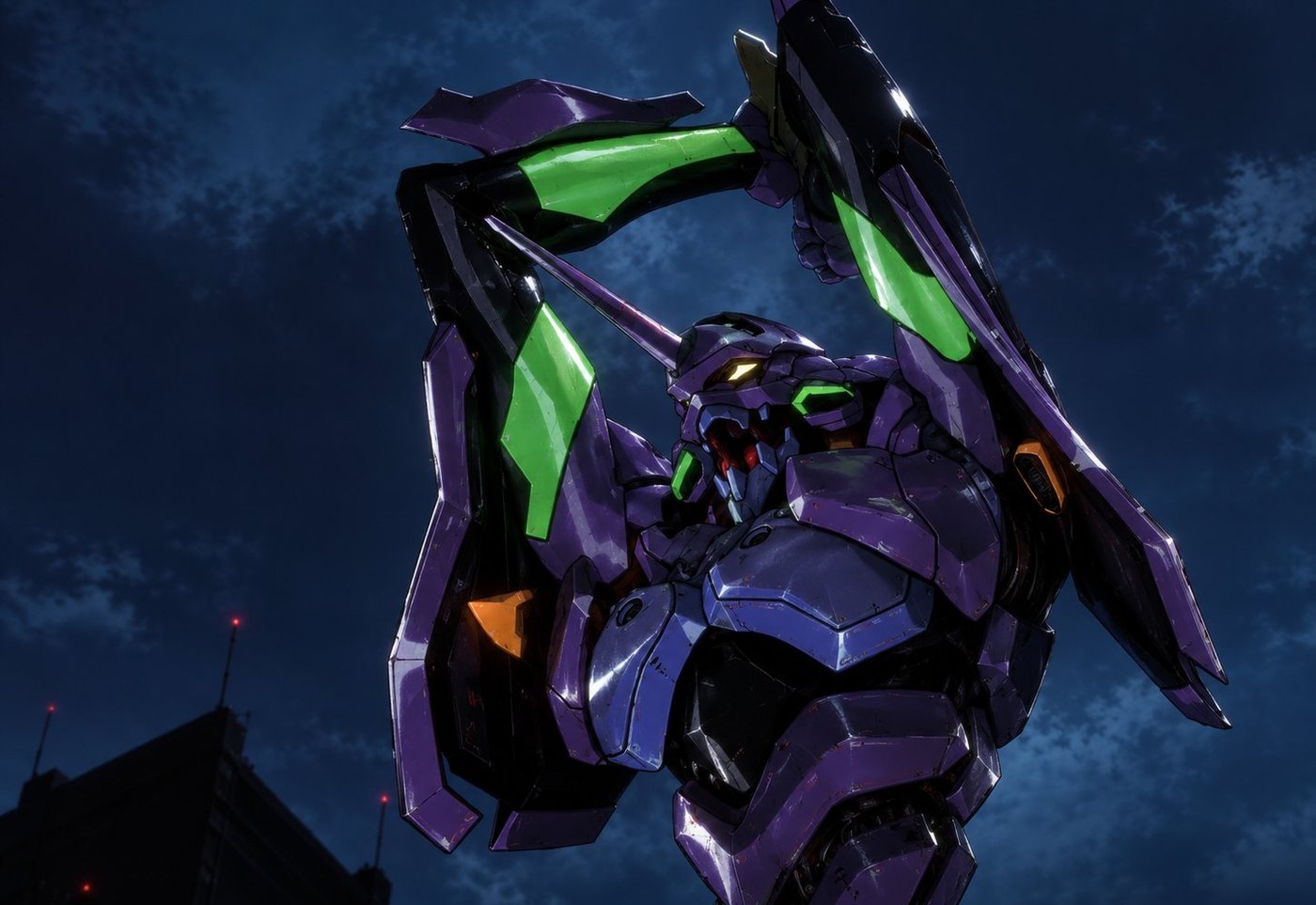
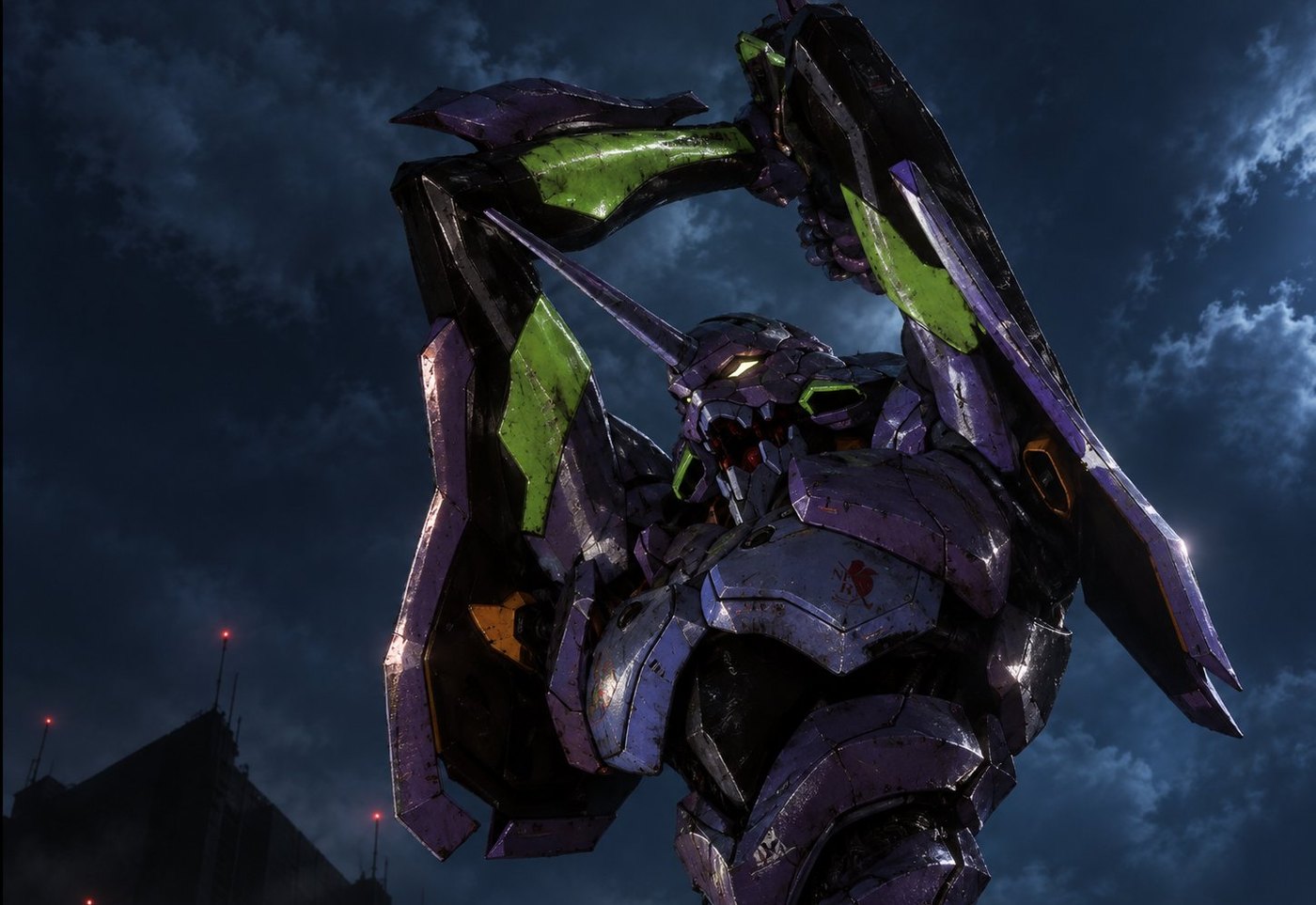
Step two is the one that flatters the technology. The armour picks up a specular response and a legible terminator, the sky gains atmospheric depth, and both the palette and the silhouette survive intact. Local value separation goes up; the design language does not change. If a relighting model only ever did this, there would be no argument.
Step three is where it gets interesting, and it is not a quality question. Roughness now varies across every panel, and edge wear has appeared along the bevels — the model has authored a history. That machine has been through something the source frame never said it had been through. Nobody specified it. It arrived because a microsurface prior trained on photographs of large metal objects expects large metal objects to be scuffed, and narrative content came along as a side effect of a material decision.
By step four the graphic language is gone: subsurface on the plating, volumetrics in the sky, a filmic curve across the whole frame. What is left is a competent VFX shot of the same subject, and the hard keyline that was carrying the silhouette read has been replaced by a soft value transition carrying none of it.
It Does Not Matter What the Model Can See
There is a technical argument doing a lot of work in this debate that deserves to be retired, and it is one this site has made. When DLSS 5 was revealed in March, NVIDIA answered a direct question by saying the model takes the rendered frame and motion vectors and infers materials from them. The natural conclusion was that a system looking only at a finished picture cannot tell a deliberate stylistic choice from a missing detail.
That may be true, but the argument should not rest on it. NVIDIA’s own materials describe engine-side buffers — depth, normals, albedo — as part of how the system is guided, and the shipping product is marketed as 3D-guided. If the answer is that the model sees more than a flat picture, the authorship question does not soften. It sharpens.
Give the model depth and it knows how far away a surface is. Give it normals and it knows which way the surface faces. Neither tells it whether the surface was meant to be matte. No G-buffer channel carries intent. The prior about what a given material ought to look like under light is not read from the frame at all — it is brought to the frame, from training. More inputs make the execution better and leave the question of whose judgement is being executed exactly where it was.

The Flatness Was Doing Something
The reflex is to read flat colour and hard edges as an old limitation that better technology finally removes. That reading does not survive contact with how animation actually works.
The film scholar Thomas Lamarre draws a distinction that is useful here: between cinematism, which organises an image around movement into depth — the Disney multiplane camera, closed compositing, the viewer pulled through the frame — and animetism, which works across a flat, open plane instead. One is not a failed attempt at the other. They are different machines for making an image mean something, and a relighting model that adds depth cues to an animetic image is not completing it. It is converting it.
Scott McCloud made the parallel argument about comics: abstraction is amplification through simplification. Detail is removed so that what remains carries more. Strip a face down far enough and readers stop observing someone else and start inhabiting the drawing. Add the detail back and you have not improved the face; you have made it belong to somebody in particular.
Games have known this for two decades. Valve’s published work on Team Fortress 2 notes that all nine classes remain identifiable from silhouette alone, with no internal shading at all — a readability constraint that drove the art direction, grounded deliberately in early twentieth-century commercial illustration rather than in photography. That silhouette is the first thing a relighting pass softens.
People Are Already Doing This
The ladder above is not hypothetical. Users have been stacking multiple passes of neural relighting over deliberately stylised games — Danganronpa, the Trails series, Shin Megami Tensei V, Higurashi. Visual novels and cel-shaded JRPGs, in other words: precisely the category NVIDIA’s own documentation says the model is not designed for.
Worth stating plainly, because it matters: those are not developer integrations. They came out of a leaked build and community mods, which is to say nobody at any of those studios chose it. That is not a criticism of NVIDIA, whose shipping partners are a short list of photoreal titles. It is the observation that a capability escapes the conditions it was scoped for, and that a control which only exists inside an official integration does not exist at all once the weights are loose.
That is the part vendors cannot control. A slider that ships with sensible defaults is still a slider, and the first thing an enthusiast does with a new one is find out what happens at the end of its travel.






Be Honest About Why the Last Panel Wins
Put the four side by side and most people pick the photoreal one, and it is worth being straight about why, because none of the reasons are that it is a better artwork.
It carries more information per pixel, and more reads as more. Photography is the culture’s default evidence that a thing is real, so photographic behaviour reads as correctness rather than as one style among several. And a comparison widget is a rigged format: the panel with the wider tonal range and the higher local contrast wins a side-by-side almost regardless of what it is a picture of. None of that is an argument that the flat frame is worse. It is an argument that the test is unfair, which is a different thing, and which is also true of every vendor comparison you have ever been shown.
What the Objection Actually Is
It is worth being precise, because the loud version of this argument and the serious version are not the same.
The serious version is about authorship, not quality. Jeff Talbot, a senior concept artist at Gunfire Games, argued that the reveal footage showed art direction being taken away from the people who set it. The concept artist Karla Ortiz made the point that a studio wanting hyperrealism would have built hyperrealism. Alex Battaglia at Digital Foundry described the model as trampling artistic intent, and separately as over-averaging toward whatever it was trained on. Cartoon Brew headlined its coverage as a shift of control from artists to algorithms.
None of those is a claim that the output looks bad. Several of the people making them would concede it often looks very good. The claim is that the person who decided how the thing should look is no longer the person deciding.
Animation has been circling the same question. WIT Studio publicly apologised after generative AI appeared in an opening sequence for Ascendance of a Bookworm, calling it a quality-control failure rather than a change of policy. Studio 100 announced AI-assisted widescreen remasters of Heidi, Marco and Anne of Green Gables — hand-drawn 1970s television, reformatted by model. And in October 2025 the Japanese content association CODA, whose members include Studio Ghibli, Bandai Namco and Square Enix, wrote to OpenAI demanding it stop training on member works.
There Is No Correct Place to Stop
This is the reason for four panels instead of two. If photorealism were the top of a quality ladder, there would be a rung at which the image becomes right and any further processing becomes excess. Step through it and find that rung.
There is not one. Each stage is internally coherent. Each is a finished picture that somebody could have intended. The progression does not converge on a correct answer and then overshoot it; it just keeps moving, because what it is traversing is not an accuracy scale. It is a style axis, and a style axis has no summit.
NVIDIA Moved, Which Is the Tell
The timeline is short and it moved in one direction. DLSS 5 was revealed around 16 March 2026. Within a day or two Jensen Huang told press the critics were completely wrong; within days after that he had softened to something closer to understanding where they were coming from. Digital Foundry, whose early coverage had been among the harshest, published a walk-back on 18 March, with Richard Leadbetter explaining they had gone from seeing the demo to going on air with very little time in between.
Then at SIGGRAPH on 20 July, NVIDIA showed the controls: Structure Intensity and Tone Intensity sliders, three separately trained models a developer can swap between, and per-object masking. Those were framed as giving studios the ability to keep their own aesthetic.
Read that sequence as engineering and it is unremarkable. Read it as a company responding to an authorship complaint and it is an admission: the controls exist because the objection landed.
Masking Is the Feature
Of everything DLSS 5 ships with, per-object masking is the one that answers the actual criticism, and it is the one least discussed.
An intensity slider expresses degree — how much of this effect do you want. Masking expresses intent — not this object, not this character, not this surface. It is the only control in the set that lets an artist say the thing the model cannot infer, which is that a given flatness is deliberate.
That matters because of how the model is built. DLSS 5 runs three networks, and the first is a semantic and material classifier: it decides, from a finished image, that a region is skin or brushed metal or wet asphalt. A classifier working from appearance alone cannot distinguish a stylistic decision from a deficiency. Pointed at a flat matte surface, its honest reading is that the surface is under-described. It will helpfully describe it.
So What Should a Studio Do
- If your game is photoreal already, this is a straightforward win and the debate barely touches you. Budget for the cost rather than the marketing number.
- If your game is stylised, NVIDIA’s documentation already tells you the model is not built for it. Treat masking as the integration, not the sliders, and mask the hero assets first — the character, the face, the silhouette that carries the read.
- If you are a player, the ladder above is what stacking passes does to art you liked. That is a legitimate thing to want; it is just worth knowing it is a choice you are making rather than a fidelity you are unlocking.
And one step outside rendering, because the shape of this is not specific to games. Every generative tool a small business touches arrives with a house style, and it is always presented as the absence of one — the neutral, professional, correct-looking default. The logo generator has a taste. The slide template has a taste. The stock-photo model has a very definite taste. Accepting a default look is not skipping a decision about style; it is delegating that decision to whoever assembled the training set, and then not being told that a decision was made.
Photorealism is not the top of a ladder. It is one rung, and it happens to be the rung the training data lives on.
Sources, dates and one caveat about them. DLSS 5 shipped 3 September 2026; revealed around 16 March; Digital Foundry walk-back 18 March; artist controls shown at SIGGRAPH 20 July. NVIDIA’s stylisation limitation is stated in its own DLSS 5 guidance. Positions attributed to Jeff Talbot (Gunfire Games), Karla Ortiz, Mike Bithell and Alex Battaglia (Digital Foundry) are characterisations of publicly stated views, not quotations. Lamarre’s cinematism and animetism are from The Anime Machine (2009); McCloud’s amplification through simplification from Understanding Comics (1993); the Team Fortress 2 silhouette constraint from Valve’s published art-direction paper. WIT Studio’s apology, Studio 100’s AI remaster programme and the CODA letter to OpenAI (27 October 2025) are reported events. The caveat: the research behind this piece could not open primary sources directly — the network blocked every fetch — so it rests on search results rather than documents read first-hand. That is why nothing here appears inside quotation marks. Where a person’s exact words matter to you, go to their original posting.
Frequently Asked Questions
Is DLSS 5 meant to be used on stylised or anime games?
No. NVIDIA’s own documentation states that the model remains limited to photorealistic rendering and is not designed for strongly stylised games such as voxel or illustrative art styles. Users have applied it to stylised titles anyway.
Does photorealism look better than stylised art?
They are different goals rather than points on one scale. Stylised art removes detail so that what remains carries more meaning, which is why Team Fortress 2’s classes are identifiable from silhouette alone. Photoreal rendering adds detail that can reduce that readability.
What do artists actually object to about DLSS 5?
Authorship rather than quality. The recurring argument from people including Gunfire Games’ Jeff Talbot, Karla Ortiz and Digital Foundry’s Alex Battaglia is that the art direction stops being set by the people who set it, not that the result looks bad.
Can developers stop DLSS 5 changing their art?
Yes. Alongside Structure Intensity and Tone Intensity sliders, NVIDIA shipped per-object masking and three swappable models. Masking is the control that expresses intent rather than degree, and it is the one that answers the criticism.
Why does AI relighting add rust and scratches that were not there?
Because the first of DLSS 5’s three models is a semantic and material classifier working from the finished image. Having learned from photographs, in which large metal objects are usually worn, it reads a clean flat surface as under-described and fills in what it expects.
Did NVIDIA change its position after the backlash?
Its public posture moved. Jensen Huang initially said critics were completely wrong and softened within days, and at SIGGRAPH in July NVIDIA presented artist controls framed as preserving a game’s aesthetic.